January/February 2010 Newsletter from didjshop.com |
 Editorial Editorial
Didjshop.com is proud to be celebrating a double milestone this year.
The first huge milestone is that our Didjshop.com website went life ten years ago (in January 2000) and we got our first didgeridoo order at the end of January 2000. It all seems soooo long ago :-). Please see below for a few facts related to the Didjshop.com anniversary which might interest you.
As most of you would know we have sold didgeridoos for much longer than ten years. In fact we started wholesaling didgeridoos in 1992 under our other trading name, The Didgeridoo Specialist, so the second milestone is that our didgeridoo business is becoming of legal age this year :-). And while it would be confusing to you, we take it as a compliment that many of our competitors call themselves 'didgeridoo specialists' in the hope that they might siphon off some of our business, so please be aware.
When I started eighteen years ago I certainly had no idea that I would be doing this business for so long, nor did I have any idea how big and successful this business would become. I guess we must be doing something right :-). Especially considering that we have not done any advertising and that we have not made any effort to grow the business.
In fact we have actually reduced our wholesale business as I do not want to become a total slave of any business, not even such a wonderful business as selling didgeridoos. Only last week we had to disappoint someone who wanted to order 100-200 didgeridoos from us. And while I do feel sorry to disappoint potential new customers, I know there are other didj sellers who will benefit from this and I also value my lifestyle high enough than to strive for bigger profits. I am very happy and grateful that the Didjshop has produced a very consistent income for over a decade for myself, for our workers and for our suppliers, and as I have no ambitions to grow much bigger, our main commitment now is to our retail customers.
I am very aware that this retail business is possible only because of the wonderful support we have enjoyed from all of you, whether it is through your orders or your word of mouth advertising.
So please let me say a big THANK YOU to all of you readers and especially to all of our customers for supporting Didjshop.com.
Over those ten years a rather large global didgeridoo community has grown, with over a thousand people offering their didj related services in our Didjnet, hundreds of people discussing didj related topics in our Didj Forum and with more and more people participating in our Worldwide Didgeridoo Meditations. Please read more about the last and next global didj event below.
As most of you would know, as part of the celebration of our tenth year on the internet we are giving away three great didjes in our 2009 draw. The winners have been drawn in January and the didjes have just arrived on the doorsteps of the lucky winners (see below). One didj each went to the USA, Germany and one to Melbourne in Australia.
A new year also means a new questionnaire. The 2010 Didjshop questionnaire has some wonderful new questions thanks to the many great suggestions we received from readers.
So please go and provide your answers and comments, in return you will receive two entries to our 2010 draw. This year we will not be giving away a didj of our choice, but we will give away a didj shopping voucher over A$1000.- (one thousand Australian dollars). This means the winner will be able to choose which didj he/she wants (or even choose two or three didjes).
Many of you have also been curious to hear the answers to the questions in last year's questionnaire. We have just uploaded the first comments, so please read more below, where you can also find some initial statistics from the 2009 questionnaire.
Next you can read how some of our customers who own at least ten other didjes compare their Didjshop didjes to the other ones. In that newsletter section below you will find also links to the first comments on this year's questions.
Last but not least this month Aboriginal news section is quite big and the first and last stories are so wonderful that we encourage all of you to read them.
We are enjoying a good monsoon this year and throughout this newsletter we will share some images of this very wet time with you.
We hope you will enjoy this anniversary issue and we trust that our global didgeridoo community will continue to grow...
Svargo
|
 Ten Years on the Internet Ten Years on the Internet
It was 10 years ago that we sold our first didj through the internet. In a sign of things to come our first retail didgeridoo customer actually bought another didj soon after and ended up buying ten didgeridoos from us over the next few years.
Since that first retail sale we have retailed over 4,000 didjes into over 70 different countries! That is a lot of wood, over ten tonnes in fact!
Isn't the internet a wonderful invention? Sometimes I am simply amazed that we can sell directly to so many people and countries all over the world. It is something that was simply impossible for a small company like Didjshop before the internet came along and connected us all. We used to sell into Europe and the US before, but only wholesaling to music instrument shops, which just did not allow for the wide variety of didjes we can offer now, nor for the customer service we can now provide no matter where in the world our customers are.
I remember we used to joke about the fact that virtually millions of dollars, more than enough money to feed half a dozen families, would come down the telephone line into the modem of our computer. It was only two years ago that we finally got broadband (broadband in Australia is actually rather pathetic and rarely delivers more than 50kb/sec).
We are certainly known for our didgeridoos as we sell four times as many didjes as we sell boomerangs for example. Considering that our didjes typically cost ten to twenty times as much as our boomerangs, this is quite an achievement.
An even bigger achievement is that ~30% of our orders come from repeat customers and some of our customers have placed more than ten orders with us, which we believe is testimony to our high workmanship and sound quality of our didjes (please read some of their comparisons below). We see it as a good reflection of the fact that we do not spend any money on advertising, but rather put that money into customer service and ensuring we have a quality product.
Talking about happy customers, by now we have received over one thousand testimonials from our didgeridoo customers!!! THANK YOU so much, to all of our customers who have provided us with all that wonderful feedback. Over 95% of those customers have rated their Didjshop didgeridoo as being as good or better than they expected. Over 90% rated our workmanship as 8 out of 10 or better, with about half giving us 10 out of 10!!! Our customer service was rated even better with over 90% rating it as 9 out of 10 or better and a whopping 80% of customers giving us 10 out of 10!!!
By now we also have over one thousand comments in our guestbook, many of which are also glowing customer testimonials.
And over those ten years our website itself has grown so much that I actually no longer know how many pages there are, but there are definitely thousands, possibly ten thousand pages or more. Despite us regularly removing all sound and image files for sold didjes (except the very small images in the sold didjes section), our website contains about a gigabyte of data, which is a fair bit larger than most websites. Since nearly five years we receive well over one thousand individual visitors every day!!!
Didjshop.com has asked its website visitors since April 2000 to answer a range of didj and Aboriginal related questions. In over nine years of questionnaires, our visitors have helped to create a very valuable resource and by now there are over a hundred thousand comments from visitors and customers available in our community section on a whole range of didgeridoo topics and Aboriginal issues. This is probably the biggest resource of its kind and it gives a good snapshot of opinions and beliefs which exist in the wider community on didj and Aboriginal issues.
And our Didjnet is probably the biggest available resource for didj related services. So whether you are looking for a performer or a teacher, someone to repair your didj or put a decent mouth piece on it, chances are you can find someone in your country or even area who can do it. And if you can provide any didj related services or want to just find some others in your area to play didj together, please join Didjnet.
And my personal favourite are the Worldwide Didgeridoo Meditations, which are connecting our global didj community four times a year. The last one on 21 December saw over a thousand participants in over 450 locations in over 50 different countries. Together we created an almost continuous wave of didj sound circling the planet. I think that is just totally awesome.
Please read more in the next paragraph.
We can assure you that we will not stop here. Didjshop.com will keep on growing, keep on connecting didj lovers all around the world and keep on providing Aboriginal made didjes which are renown around the world for their superior sound quality and workmanship. We will also continue to only buy from Aboriginal people and to support Aboriginal causes.
We have some ideas on making our community section even bigger and better, so please watch this space .... :-)
|
 Worldwide Didgeridoo Circles Worldwide Didgeridoo Circles
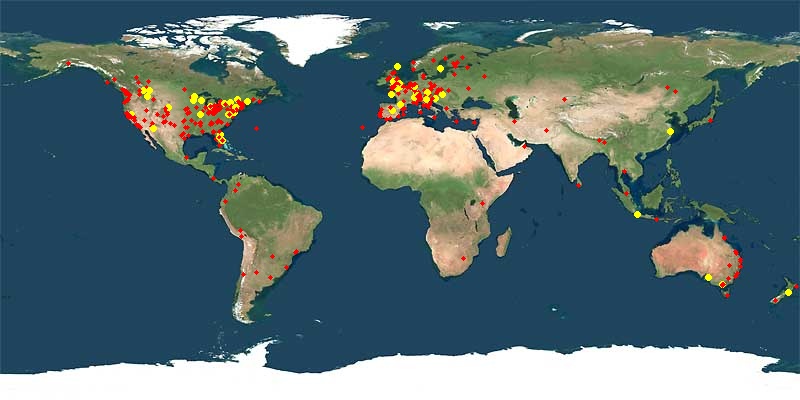
First a big thank you to everyone who has participated in the last Worldwide Didgeridoo Circle on 21 December 2009. It was the biggest such event yet with well over 450 registered locations participating in the following fifty-two countries (in alphabetical order):
Argentina, Australia, Austria, Belgium, Bermuda, Bhutan,Brazil, Canada, Chile, China, Colombia, Costa Rica, Croatia, Cyprus, Czech Republic, Denmark, Ecuador, Finland, France, Germany, Greece, Hungary, India, Indonesia, Iran, Ireland, Italy, Japan, Kenya, Latvia, Luxembourg, Macedonia, Malaysia, Mexico, Netherlands, New Zealand, Norway, Paraguay, Peru, Poland, Portugal, Russia, South Africa, Spain, Sri Lanka, Sweden, Switzerland, Thailand, Ukraine, United Arab Emirates, United Kingdom and USA.
We are getting a really good coverage of the planet and all together we produce a nearly continuous wave of didgeridoo sound circling the globe.
The only gaps we still have are in the following time zones and countries: -11:00 GMT (Midway Islands, Samoa), -10:00 GMT (Cook Islands, Tahiti), -2:00 GMT (South Georgia & The South Sandwich Islands), -1:00 GMT (Cape Verde Islands), +5:00 GMT (Maldives, Pakistan, Tajikistan, Turkmenistan, Uzbekistan) and +11:00 GMT (Solomon Islands).
So if you happen to know anyone in any of those time zones, please do invite them to participate in our next Worldwide Didgeridoo Circle.
Our next Worldwide Didgeridoo Circle will be on the 21st March 2010 and it will be held in memory of Ruby Hunter, a wonderful Indigenous woman and the first female Aboriginal singer/songwriter who has ever been signed on by a major record label.
So please mark your calendar, register with us so you will be on the map and on the 21st March, please get your didj out and play it for 45 minutes starting at your local sunset time. Then please sit for 15 minutes in silence. Enjoy!!!
|
 2009 Questionnaire Results 2009 Questionnaire Results
A new year means a new questionnaire, so please feel free to answer this years questions for your chance to win an A$1000 Didj shopping voucher.
This year's questionnaire has totally new and very interesting questions, many of which have been submitted or inspired by newsletter readers (thanks folks!).
A new year also means that our 2009 questionnaire is closed and we now can have a look at some of the results:
There were 1923 replies to the 2009 questionnaire from people living in the following 60 countries:
Argentina, Australia, Austria, Belgium, Bermuda, Bhutan, Brazil, Bulgaria, Canada, Chile, China (PR), Colombia, Costa Rica, Croatia/Hrvatska, Cyprus, Czech Republic, Denmark, East Timor, Ecuador, Finland, France, Germany, Greece, Greenland, Guernsey, Hungary, India, Indonesia, Iran, Ireland, Isle of Man, Israel, Italy, Japan, Lebanon, Lithuania, Mauritius, Mexico, Netherlands, New Zealand, Norway, Pakistan, Paraguay, Peru, Poland, Portugal, Puerto Rico, Russia, Serbia, Singapore, Slovenia, South Africa, Spain, Sweden, Switzerland, Ukraine, United Arab Emirates, United Kingdom, US Minor Outlying Islands and USA,
23.5% of respondents were female, which has not changed too much over all those years.
And the age of respondents was fairly evenly spread over the different age groups this year.
One of the questions we asked in our 2009 questionnaire was this: "Australia is importing large quantities of cheap copied Aboriginal arts and crafts from countries like Indonesia, India and China to sell to tourists (often as genuine Aboriginal art). Do you agree or disagree with this practice?"
We were very surprised by the strength of feelings out there about this particular issue:
2% of respondents strongly agree with imports
2.3% of respondents agree with imports
2.8% of respondents don't care
26.9% of respondents disagree with imports
66.1% of respondents strongly disagree with imports
that is over ninety percent of people which are against this practice. So if any of you ever come to Australia, please be very aware that the vast majority of Aboriginal art sold in Australian shops is manufactured overseas and imported. Almost all of those items are sold without revealing their foreign origins to the buyer. The shops selling them usually have large advertising insinuating that they are selling "Aboriginal art", and while they might actually have some art which is actually made by an Aboriginal person (allowing them to advertise), they fail to inform the buyer that most of their Aboriginal looking products are in fact not made by Aboriginal people. It is very deceptive, but in the huge souvenir industry it is a common practice to be price-competitive.
Most people gave very good reasons for their position on this issue and we can only hope that the Australian government will read those and listen to the well over 90% of people who do not want Australia to import Aboriginal arts and crafts.
 Another question we asked was: Another question we asked was:
"How many Aboriginal people do you think are living in Australia today? (as a reference we gave the total population of Australia as ~21,000,000)."
Here the results:
11.8% of respondents believe there are ~ 100,000 Aboriginal people living in Australia today
21.3% of respondents believe there are ~ 250,000
21.3% of respondents believe there are ~ 500,000
11.5% of respondents believe there are ~ 750,000
9.3% of respondents believe there are ~ 1,000,000
4.5% of respondents believe there are ~ 1,500,000
4.7% of respondents believe there are ~ 2,000,000
2.9% of respondents believe there are ~ 2,500,000
3.6% of respondents believe there are ~ 3,000,000
1.1% of respondents believe there are ~ 3,500,000
1.2% of respondents believe there are ~ 4,000,000
1% of respondents believe there are ~ 4,500,000
2% of respondents believe there are ~ 5,000,000
3.7% of respondents believe there are over 5,000,000
So how many Aboriginal people are there actually in Australia today?
The last complete census was done in 2008 when there were about 500,000. Considering that the growth rate for the Aboriginal population in Australia is between 1.8 and 3.4% per annum, there would be about 550,000 to 600,000 Aboriginal people living in Australia today. However most of these would not be full-blood Aboriginal people. Anyone who is of Aboriginal decent and accepted as an Aboriginal person by an Aboriginal community is counted as an Aboriginal person, even if she/he has for example only a great-grandfather who was a half-cast.
From the above responses we can see that most people were at least in the right ballpark.
Next we asked people:
"How many Aboriginal people do you think were living in Australia when Captain Cook arrived two hundred years ago?"
2.9% of respondents believe there were ~ 100,000
4.7% of respondents believe there were ~ 250,000
10.9% of respondents believe there were ~ 500,000
14.8% of respondents believe there were ~ 750,000
13.9% of respondents believe there were ~ 1,000,000
7.8% of respondents believe there were ~ 1,500,000
9.2% of respondents believe there were ~ 2,000,000
4.2% of respondents believe there were ~ 2,500,000
6% of respondents believe there were ~ 3,000,000
2.1% of respondents believe there were ~ 3,500,000
4.2% of respondents believe there were ~ 4,000,000
1.4% of respondents believe there were ~ 4,500,000
3.5% of respondents believe there were ~ 5,000,000
14.4% of respondents believe there were over 5,000,000
And the simple answer to this question is we do not really know how many Aboriginal people were in Australia 220 years ago. In 1930 anthropologist Radcliffe-Brown estimated the pre-settlement population to have been at least 300,000. This estimate was accepted by the government at the time despite a total lack of any evidence.
Recent estimates are between 750,000 (Mulvaney and Kamminga (1999)) and one million (Australian bureau of statistics).
What we do know is that they started to die like flies soon after the British came here. And while many were killed by the British settlers and soldiers, many more succumbed to diseases for which they had no resistance, like smallpox and chickenpox for example.
The 1901 census reported only 67,000 Aboriginal people in Australia and even in 1950 estimates were as low as 76,000.
Anyway it seems that the most likely scientific estimates coincide again with what most respondents believe.
 Now let us have a look at the difference between present and pre-British-settlement population estimates given by respondents: Now let us have a look at the difference between present and pre-British-settlement population estimates given by respondents:
1.6% of respondents believe there to be over 4,000,000 more Aboriginal people today then when Captain Cook arrived
1% believe there to be 3,00,000 to 3,900,000 more
2.9% believe there to be 2,00,000 to 2,900,000 more
2.9% believe there to be 1,00,000 to 1,900,000 more
3.4% believe there to be 500,000 to 900,000 more
4.2% believe there to be 100,000 to 400,000 more
5.7% believe there to be about the same
21.7% believe there are the same or more Aboriginal people then when captain Cook arrived
15.5% believe there to be 100,000 to 400,000 less
19% believe there to be 500,000 to 900,000 less
18% believe there to be 1,000,000 to 1,900,000 less
11.3% believe there to be 2,00,000 to 2,900,000 less
6.6% believe there to be 3,00,000 to 3,900,000 less
8% believe there to be over 4,000,000 less
It seems that most people are aware of the magnitude of the (at least partly unintentional) genocide which happened and if anything even over-estimate it.
It is encouraging to see that our website visitors are such an educated lot and that so many people gave correct estimates or at least were pretty close, well done folks!
The Aboriginal population is presently growing faster than the rest of Australia's population and the Australian National University estimates that by 2030 there might be about 800,000 Aboriginal people in Australia, which would be about the same as there were before the British arrived.
What I find interesting to contemplate in this context is that according to our government by that time (2030) there would be about 25-30 million non-Aboriginal people in Australia, which obviously weren't there 250 years ago.
As a result of more and more people Australia's marvelous environment has degraded a lot since the British arrived, and while I am convinced that 30 million people is not sustainable in the long run, I do wonder what the ideal population for Australia would be, in order to ensure a healthy and diverse environment. This interesting and very educational video claims that worldwide even a reduction to 1/4 of the present population would be unsustainable, which would mean less than 5 million people in Australia. In fact the video argues for a lot less, so just maybe Aboriginal people already reached truly sustainable levels before white people arrived and started to settle here...
We will bring you some more results from last years questionnaire in our next newsletter.
A big THANK YOU again for all of you who have contributed to this data and please do answer this year's questions - you might just win a thousand dollars :-)
|
 New Comment Sections & Didj Comparisons New Comment Sections & Didj Comparisons
We have just uploaded the first comments to some of the new questions in our new 2010 questionnaire. We think there are so many great replies to those questions, that rather than present you with some samples, we encourage you to have a read yourself:
"In your opinion what is the most important thing Aboriginal people could learn from our Western society?"
"In your opinion what is the most important thing our Western society could learn from Aboriginal people?"
"In your opinion what is the main difference between Aboriginal and Western society?"
"How would you describe the sound of the didj?"
And if you have not yet filled out our 2010 questionnaire, please do so.
As usual we have also added visitors comments about our website.
 As mentioned before we have received by now over a thousand testimonials from our customers. We thought you might be interested to know how they compare their Didjshop.com didj with other didjes they own. So here are a few of those comparisons (only from customer which own a lot of other didjes to compare to): As mentioned before we have received by now over a thousand testimonials from our customers. We thought you might be interested to know how they compare their Didjshop.com didj with other didjes they own. So here are a few of those comparisons (only from customer which own a lot of other didjes to compare to):
- Kei Tomono from Japan (owns 17 didjes): "af343 is Super best Sound Quality and Super dot art it is No.1"
- Shannon Slate from USA (owns 15 didjes): "The sound quality is far superior than my other didjes."
- Bernard from USA (owns 14 didjes): "It is a benchmark didge in a number of areas. No didge can be the best in ALL areas, but this one is excellent in many areas."
- Anonymous (owns 12 didjes): "The best."
- David from United Kingdom (owns 11 didjes): "Price wise it's better than all the other didj's given the sound it makes, it is also excellent value for money. If I had to rationalise my didjes I would keep only five and af398 would be one of them."
- Robert from USA (owns 11 didjes): "It's the best. My #1 most favorite, most unique, best sounding didj I have."
- Aaron from USA (owns 11 didjes): "The sound quality surprised me and I felt it was better than the grade you gave it so excellent value for the money and it is up there with the best of my others."
- Arpad Toth from United Kingdom (owns 10 didjes): "The best one ..as I said compared to the one that was 2000 plus shipping;) af170 was really the best buy ..Good value and most enjoyable!! when I play this one gives it the magic"
Thanks to all our customers for their great comments and feedback. And thanks for telling friends and other people about us. We rely 100% on word of mouth and are grateful that so many of you tell others about Didjshop.com.
If you ever bought a didj from Didjshop.com, please do participate in our customer survey.
And if you are interested, you can read more comments on a wide range of subjects.
|
Winners!
This is the draw everyone was waiting for. Over A$3500 worth of didjes have just been given away to celebrate Didjshop.com's tenth anniversary on the internet.
And the winners are:
 The first prize went to: The first prize went to:
Trey Gehring from Baton Rouge in Mississippi, USA
Trey has this feedback on Didjshop.com: "I appreciate that all the didj's are termite hollowed traditional didj's"
As most respondents, Trey strongly objects to the import of 'Aboriginal art' into Australia and we very much agree with his comment on this subject: "The Aboriginal people deserve the payment for their craft as it is their culture. It is wrong to represent cheap knock-offs Aboriginal craft that is degrading to the culture."
 The second prize went to: The second prize went to:
Andrew O'Connor from Melbourne, Australia
Andrew said this about our Didjshop.com website: "Love it, nice to see there is a community out there for everyone".
Andrew also shared this wonderful story about his didj playing experience: "I had a motorcycle accident 3 years ago and i used to sit out the front of my parents house and play the didge to a family of magpies the mother would sit on the fence in front of me whilst to my right the father would keep close watch on me and the youngling would sit at the bottom of the didge and sing as I played (sometimes it would stick its head up the bell and see where the sound was coming from) i still play there at times now and the flock has gotten bigger and the new younglings sometimes come and sing next to my didge"
 And the third prize went to: And the third prize went to:
Peter Huber from Lichtenwald in Germany
Here is Peter's comment about our Didjshop.com website: "It is a complete site. I think it is a fair company with human doing"
And Peter had this to say about our service: "First quality in delivery time, support and answering my questions. Supreme"
These three prize didjes have just been received by their new lucky owners and we are waiting to get their comments on their wins and a photo of them and their new didjes, which we will provide in our next newsletter.
And for all of you who missed out this time, we have another big prize to be won in our 2010 Competition. To get your two entries into the draw, please simply answer our 2010 visitor questionnaire. You can also win extra entries in the draw if you write a short review about any books about Aboriginal culture/issues or the didjeridoo or movies that have Aboriginal actors or didjeridoo sounds or images.
|
 Aboriginal News Aboriginal News
There are some great news stories in this anniversary issue, the best is clearly the win of the first ever Aboriginal Rugby team over the best Australian Rugby players! Enjoy!
- On the second anniversary of the Federal Governments apology to the Stolen Generation a unique game of rugby was played at the Robina stadium on the Gold Coast, which was packed to capacity with 26,000 fans. The inaugural Indigenous All Stars team played against the NRL All Stars, the best players in the National Rugby League.
This event was independently organised after Aboriginal players have unsuccessfully tried for years to get an Aboriginal team accepted by the Australian Rugby League (ARL). The ARL previously rejected a suggestion for a full-strength Aboriginal team to play an annual match against Papua New Guinea. So this was a truly historical game played on a historical date.
Gordon Tallis, who helped with coaching the Aboriginal team, said after the game: ''I know the ARL didn't want this game but these guys like Preston, Michael Searle and David Gallop have pushed hard and look what they've done. It's for the fans.''
It was over 15,000 of those fans who actually selected the players for the "Dreamtime Team".
Just before the game traditional Aboriginal dancers performed a wild dance with spears and they seem to have done a good job of intimidating the All Stars :-)
The Indigenous side took the lead only four minutes into the play, when Wendell Sailor, playing his last rugby league match, converted a kick by Scott Prince. To the crowds delight, Wendell celebrated the early lead by using a corner post as a makeshift didgeridoo.
The star-studded NRL All Stars favourites fought back gallantly, but the passion of the first ever all Aboriginal team was no match and the 'Dreamtime Team' ended up with a well earned 16-12 victory sealed by a Jamie Soward try in the 74th minute.
All profits from the game, estimated to be about two million dollars including the players' payments, will be invested in community programs, mostly indigenous programs.
It is wonderful to see so much pride and that such a successful event happened despite the ARL's reluctance.
We notice the symbolism of the success coming from Aboriginal people taking things into their own hands and making them happen, especially when contrasted against the next story:
- Australia's Prime Minister Kevin Rudd promised to make yearly reports when he apologised to Aboriginal people two years ago. Last year the Prime Minister didn't have much to report and said: "There will be many bumps and setbacks along the road but the alternative is to do nothing." At the time the government was heavily criticised for continuing the intervention and the suspension of the racial discrimination act.
One year on Kevin Rudd delivered his second "Closing the Gap" statement to Parliament on the 11th February. In it he claimed that more Aboriginal people are in work and more are completing high school, but he did not elaborate whether this is simply due to the growing Aboriginal population. We noticed that he referenced those increases to 2002 and 1995 respectively, which are both a lot earlier than the beginning of the intervention. To us this looks a lot like raisin picking data to make things look good, rather than genuine progress.
Kevin Rudd did admit that a decrease in the life expectancy gap between Aboriginal and non-indigenous people from 17 to about 11 years is simply due to more reliable data being available now.
He also made some new funding announcements, like the planned opening of new school-based sports academies and a few million for health services for new-born babies and their mothers.
Opposition leader Tony Abbott has criticised that the government has relaxed some of the welfare quarantining measured, indicating that the Liberal party would be even more totalitarian and discriminatory towards Aboriginal people.
The opposition also accused the Prime Minister for allegedly breaking his election promise to create a bi-partisan commission together with the opposition leader. However we do remember that Kevin Rudd did actually create the commission, but the then opposition leader Brendan Nelson pulled out, so in our opinion this is unwanted and misleading grandstanding by the Liberals. We rather see them making constructive suggestions on how to help Aboriginal people instead of using them simply to try to score political points.
What we think is much more serious is that the racial discrimination act is still suspended after over two and a half years despite the Labor party's election promise to re-instate it and despite Australia's obligations under human rights conventions. It is unacceptable that this government (with the silent support of the opposition) continues to treat Aboriginal people like lower class people with less rights. This is apartheid and should not happen in Australia in 2010!
- And this next story gives you a small sample of what that apartheid can look like for affected Aboriginal people:
On any normal day in a Darwin supermarket you will see a separate check-out lane for Aboriginal people with "Basics Cards". These cards are issued as part of the intervention's welfare quarantining to Aboriginal people so they can spend part of their welfare money only on essential items or food.
What makes this system really degrading for the people affected is not just that these cards can only be used in selected shops, not just that the checkout lanes in supermarkets are dividing people by their race, but that the people who have to rely on buying their food with those cards cannot easily check the remaining balance. To do that they have to go to a centrelink office.
So it is a frequent occurrence in shops and supermarkets that these Aboriginal people are forced to leave part or all of their intended shopping behind and suffer the associated embarrassment and shame.
One would have expected such scenes in South Africa decades ago, but they are happening in Australia today! What a shame!
 Regular readers would be aware of the Australian government promised to spend 672 million dollars on Aboriginal housing in remote Northern Territory communities. That was nearly two years ago and the Strategic Indigenous Housing and Infrastructure Project (SIHIP) was launched soon after in April 2008. Only now the first two houses constructed under this program are finally ready for occupation in the remote community of Wadeye. Not much but at least a start. Regular readers would be aware of the Australian government promised to spend 672 million dollars on Aboriginal housing in remote Northern Territory communities. That was nearly two years ago and the Strategic Indigenous Housing and Infrastructure Project (SIHIP) was launched soon after in April 2008. Only now the first two houses constructed under this program are finally ready for occupation in the remote community of Wadeye. Not much but at least a start.
The Housing Minister Chris Burns has promised that by the end of 2010 there will be 150 houses ready and the Prime Minister has claimed that another 50 houses are currently under construction and that the program's goal of 20% Aboriginal employment has been far exceeded and that the actual figure is 35%.
That is welcome news, but in our opinion it means that the initial figure was unacceptably low and we believe for the program to be successful and ongoing, well over 50% of people working in the program should be Aboriginal.
The government has also come under attack from the NT opposition for using SIHIP money to pay for the upgrade to the Alice Springs town camp, where the government has finally managed to bully the Traditional Owners into leasing their land back to the government. Senator Nigel Scullion said he and everybody else had been in the belief that additional funds would be used for the town camps. We do remember that the initial announcement of the 672 million was for remote community housing and the Alice Springs town camp cannot be called remote.
But Federal Aboriginal Affairs Minister Jenny Macklin claims that the government always wanted to work in the town camps. We note that she avoided to clearly state in her response whether or not the government made it clear that the funds to pay for that work would come form the SIHIP funds. We certainly were not aware of that. If, as Jenny Macklin now indicates, the upgrades to town camps in Alice Springs, Tennant Creek and Borroloola will be paid for out of the SIHIP funds, there will be a lot less money left for remote area housing.- We are very sorry to have to announce that renown Aboriginal singer Ruby Hunter has just passed away on 18th February. Ruby, a Ngarrindjeri woman from South Australia was born in 1955 and as many others of her generation was forcibly removed from her family when she was eight years old. At age sixteen, as a homeless teenager she met Archie Roach, another famous Aboriginal singer/song writer. Ruby has travelled the world and sung with people like Bob Dylan and Tracey Chapman. Her first album, 'Thoughts Within' was released in 1994 and she was the first Indigenous woman to be signed up by a major record label.
Ruby Hunter was one of these wonderfully inspiring Aboriginal women and we trust that she will continue to inspire Indigenous woman all over the world to find their voices and dare to speak their stories.
Please let us all remember and honour Ruby Hunter during our next Worldwide Didgeridoo Meditation on 21 March.
- Last but not least a few short but good news items:
- The Regional Anangu Services Aboriginal corporation is no longer running at a loss. This is a widespread problem with Aboriginal corporations. So it is wonderful to hear that in this case a year-long restructuring project has resulted not only in the corporation no longer operating at a loss, but also providing more services for the funding they receive and most importantly employing more Indigenous people. This proves that Aboriginal corporations can be structured to run successfully and we hope that this will happen with many more...
- The Queensland government has made a commitment to offer 2,800 public sector jobs to Aboriginal people and has thus become the first state government to sign up to the Australian Employment Covenant which aims to find 50,000 jobs for Aboriginal people.
- Statistics reveal that community programs in Redfern had a marked effect on reducing crime, with robberies committed by Aboriginal juveniles falling by 80% over the past year. This is wonderful evidence for what we have always advocated: giving Aboriginal youth something meaningful to do is much more effective at reducing crime rates than more policing and prosecution. Hopefully governments around the country will read this report and duplicate such community programs elsewhere.
|
Keep on didjing until the next newsletter and may our Worldwide Didgeridoo Community keep on growing...
from Svargo and the DIDJSHOP.COM team
|
To unsubscribe, please visit our subscribe / unsubscribe panel
Use the same online control panel to update your email address, or to switch between HTML and plain text email format. |
|
|