January 2008 Newsletter from didjshop.com |
||||||||||||||||||||||||||||||||||||||||||||||||||||||||
|
||||||||||||||||||||||||||||||||||||||||||||||||||||||||
|
||||||||||||||||||||||||||||||||||||||||||||||||||||||||
 2007 Visitors Questionnaire
 "Did you know that almost all didgeridoos not made by Aboriginal people are sold without clearly stating this fact?"
| All Visitors | Didj Owners Only | |||||
| Which of the following statements regarding didgeridoo sales and Aboriginal people would you agree or disagree with? | Agree | Disagree | Don't Care | Agree | Disagree | Don't Care |
| Only Aboriginal people should be allowed to play didgeridoos | 3.1% | 93.9% | 3.0% | 1.9% | 96.2% | 1.9% |
| Only Aboriginal people should be allowed to make didgeridoos | 28.0% | 68.0% | 4.0% | 22.3% | 74.7% | 3.0% |
| Only Aboriginal people should be allowed to paint Aboriginal designs | 51.3% | 44.4% | 4.3% | 50.8% | 46.2% | 3.0% |
| Non-Aboriginal didgeridoo makers should pay royalties to Aboriginal people or organisations | 62.0% | 32.7% | 5.3% | 56.7% | 38.3% | 5.0% |
| Any didgeridoo sold should clearly state if it is not made by an Australian Aboriginal person | 94.0% | 4.0% | 2.0% | 94.8% | 3.6% | 1.6% |
| Any painted didgeridoo sold should clearly state if it is painted by an non-Aboriginal person | 91.0% | 5.4% | 3.6% | 92.0% | 5.0% | 3.0% |
Some people wrongly assumed that we would want only Aboriginal people to play and make didgeridoos and paint Aboriginal designs, some even attacked us because they thought this to be the case. Truth is we would say 'no' to any of the first three questions and answer 'yes' to the last three questions.
Since we are selling didgeridoos all over the world, we certainly and obviously have no problem with non-Aboriginal people playing didgeridoos, we actually encourage it. The main reason we included this question is as a kind of reference, to see how many people would just say yes to everything we ask. It seems that even these 'yes' answers are genuine since only less than 0.2% of all respondents said 'yes' to every one of these question.
We also have no problem with non-Aboriginal people making didgeridoos in general; we actually give instructions on how to make PVC didgeridoos on our website. However we regret that the huge amount of didgeridoos made today by non-Aboriginal people are increasingly depriving Aboriginal people of income and work opportunities. So we definitely would like to see each didgeridoo which is not made by an Aboriginal person to be clearly labelled as such at point of sale. It is wonderful to see that almost 95% of respondents agree with that position and hopefully more and more businesses using such deception will either change or go out of business.
What you can do is to clearly ask any didgeridoo seller whether all of his/her didgeridoos are cut by an Aboriginal person, made by an Aboriginal person and/or painted by an Aboriginal person and get the answer in writing or openly record it (many shop owners lie verbally as they can deny it later, but when they put it in writing or it is recorded they know that they can be prosecuted or sued).
 We also believe that anyone making money on didgeridoo sales should return a small part of that money to Aboriginal people or an Aboriginal organisation or cause. We certainly believe that this is a small thanks, an acknowledgement and a small return for making money on someone else's cultural heritage that everyone in the didgeridoo industry should adopt. We encourage you and everyone else to not buy from people who make money on Aboriginal culture without returning anything. Again most respondents support this view.
When it comes to Aboriginal artwork, we believe no non-Aboriginal person should make any money on producing Aboriginal designs unless they have specific permission form the relevant Aboriginal elders and/or artists to do so - to do otherwise is cultural theft. In our view it is not a problem to paint your own didgeridoo or whatever else with Aboriginal style art as long as you do not make money with it. Over half of respondents believe that Aboriginal designs should not be produced by non-aboriginal people at all. Hopefully this is due to a recognition of the sacredness of many of those designs and a general wish to at least leave the production of Aboriginal art to Aboriginal people.
Didgeridoo owners were less likely to answer 'YES' in the first three questions, but more likely to answer 'YES' to the last two. This is a clear message to all didgeridoo sellers that customers want honesty over authenticity.
We are surprised that didgeridoo owners are less likely to want royalty payments by non-Aboriginal makers than general website visitors. However those non-Aboriginal didj makers should note that well over half of their potential customers would like to see them give some money to Aboriginal people or causes. This is a very small price to pay in return for making money on Aboriginal culture and it will clearly increase your sales to do so.
And here a few more interesting results from the 2007 questionnaire:
28.85% of all respondents and 44.35% of didgeridoo owners have made their own didgeridoo.
Only 5.32% of respondents have tried to play the didgeridoo and could not get the base drone.
65% of respondents and 96% of didgeridoo owners can play didgeridoo.
27.6% of respondents and 61% of didgeridoo owners have learned circular breathing.
Last not least we are pleased to learn that 13.48% of all respondents and 21.16% of didj owners have participated in at least one of the Worldwide Didgeridoo Meditations. That is wonderful and indicates that many participants have not added themselves to our list of supporters. So if you are one of those or intend to participate in the next Worldwide Didgeridoo Circle on 20th March, please add yourself to the list and the map. Thanks
You can read some of the hundreds of more detailed comments on authenticity and on Didjshop.com HERE.
For all of you who did not win in 2007, don't worry, we have an even nicer didgeridoo as price for our 2008 questionnaire that has many new and different questions. So please fill out our 2008 questionnaire for your chance to win a wonderful Brad Gosam didgeridoo or one of the monthly Didjshop shopping vouchers.
 Customer Testimonials
We received so much wonderful feedback from our customers on their new Didjshop didgeridoo in the last few weeks that we just have to share some of them with you:
- Arpad Toth from United Kingdom: "No dislike...it is a B and actually I think is my favourite...I ordered many didgeridoos since from different shops in Australia..one of them was 2000 dollars (burrngupurngu:) but not playing it much..This big Didj of yours (af170) can always give me what I enjoy in a Didj and can take me to those dimensions I love to be in every time!!
Thank you, Arpad" - Jutta from Germany: "It's a perfect instrument, there is nothing I dislike. It looks great and the sound is incredible wonderful. My didge-teacher also was very impressed and said, there is no possibility to get such an instrument in Germany."
- Chad from USA: "It's huge!!!! I love how beautifully it plays, and it amplifies perfectly!! Be it light harmonics, or booming rhythms, the clarity is great!!!"
- Jeremy Prentice from Australia: "Beautiful sound with great backpressure - it took some learning to play a lower key, but now it just purrs along and has such a fantastic sound. The quality of it has helped me expand the range of sounds I can now make. Well worth the investment, as I thought it would be! I What inspired me to buy it was actually another didj at a different shop (which was also an A), but I wanted to try out your quality ratings and service - well, it was all better than I expected, and when I went back to play the other didj, after playing my new one from you, I realised just how good the one I bought from you was! I will recommend you guys to anyone (and everyone!) looking to buy a didj."
- Kelly Sandy from USA: "I like the clear, resonant sound made by this Didgeridoo. I am quite amazed because the didj was only rated a 1-C. Your quality rating scale does not lie. Also, the didj allowed me to learn circular breathing easily. It's size and carrying case allow for easy transportation."
- Jonathan from United Kingdom: "It has a pretty good sound and is easy to play. I like the simplicity of its style. the glazing is super important as i live in the UK and a yidaki that i previously owned cracked due to cold weather here in winter. I hate that it has a number engraved on it however."
- Kei Tomono from Japan: "I love it Very much and Brad's Dot Painting is Super High Quality Very Very Beautiful."
- Jerome from France: "This didj is awesome, I never Heard something like this, and still it's a low to medium concert class... It's beautiful, and simply there is nothing else to say for the price!"
- Anonymous from Australia: "The unique didj purchased from you is better then expected! We are very impressed with the sound, design, make and beautiful artwork. The service provided by your company is terrific, you live up to your very elaborate and informative website from the high quality product to the quick and professional delivery. We are very happy with the didge we purchased from you and will be recommending didjshop.com with the highest esteem."
- Gary Diggins from Canada: "I like the concentrated sound of this didj, coupled with its clear overtones. It has a good back pressure for circular breathing and is not all that heavy in terms of weight. I didn't have an E in my collection and pianists or guitarists love the fact that it's in tune!"
- James Lewis from United Kingdom: "I love this didge, i have two expensive didgeridoos, this being one of them. I love the deep key it has that just send the vibrations right down your bone and the calls sound completely sensational. It was thanks to this didge that i learned to circular breathe!"
- Anonymous: "I love it! It sounds better than any didj I've ever played and I like the fact that it was made by aboriginals and by an ethical company."
- Jonny Monument from United Kingdom: "Likes. Monster sound. Stunning artwork. fabulous everything. Honestly. Sounds corny, but this is my perfect didj."
- Herve Vaudan from Switzerland: "I love THE sound rich and round and what to say about the blue tongue lizard painted by Brad? Just wonderful!!"
A big THANK YOU to all of our customers for your continued support and your wonderful feedback.
If you have not yet done so and have bought a Didjshop didgeridoo at any time, please fill out our customer questionnaire for your chance to win an amazing Brad Gosam didgeridoo - and you want to do so very soon as entries to this special draw will close on 29th February.
 2007 Price didgeridoo Winner!
The winner of the 2007 prize didgeridoo valued at over A$1500 is Ilya Suvorov from Kursk in Russia.
Congratulations, Ilya, it is great to see a Russian didgeridoo player win this year. It is certainly a sign of the didgeridoo spreading to the furthest corners of the world. We trust that Ilya will enjoy this beautiful concert class didgeridoo.
Here is what Ilya said about Didjshop.com: "The didjshop is the PORTAL of didgeridoo community. your DIDJNET and EVENT CALENDAR is just a great idea"
This is Ilya's comment on the fact that over 90% of didgeridoos are not made by Aboriginal people: "If you're talking about plenty of those didgeridoos have to be qualified under concert class - I agree it's a sad thing. however a person who is really interested in didgeridoos would have at least one Aboriginal didj (I have no one yet. YET). my sole didj was made by a Moscow didgeridoo crafter out of oak. I qualify it being middle concert class it's just an excellent didj."
As we can see on the UPS tracking site, Ilya has just received his first real Aboriginal made didgeridoo and we are looking forward to receive a picture of him with the prize didgeridoo and some comments on it. We hope that the termite eaten Australian eucalyptus compares well with his excellent Russian made oak didgeridoo ;-) .
Meanwhile we have created a completely new questionnaire for 2008 with many new and different questions. filling out our 2008 questionnaire will give you an entry in the draw for yet another great didgeridoo to be given away. So please answer a few questions for your chance to win a beautiful Brad Gosam didgeridoo (see on the right)!
Aboriginal News
Read about 'Australia Day' and 'Mourning Day', Christmas spear fights and baby bonuses, boomerangs and deaf dancers in this month' Aboriginal news:
- First and foremost we need to report what should have been news, but still has not happened. The newly elected Rudd government has missed what must be the very best opportunity to say 'Sorry'. They went to the federal election in November promising to say sorry to Aboriginal people for all the wrongs of the past. It would have been a wonderful gesture for the new cabinet to have their first meeting in an outback Aboriginal community and use that opportunity to say 'Sorry', but it did not happen. This Saturday just past (26th January) was Australia Day, a national holiday marking the birth of the Australian nation. On that day 220 years ago Arthur Phillip took possession of what was then known as the colony of New South Wales. Understandably many Aboriginal people despise the day and mourn it as "Invasion Day" instead (also see story below).
We believe it would have been the perfect opportunity for Australia's new prime minister elect Kevin Rudd to use his address to the nation on Australia Day to say 'Sorry' to all Aboriginal people for all that happened in the past. What better opportunity to unite a nation, what better opportunity to give Aboriginal people a good reason to join into the celebrations of the very day they so far consider the blackest in their history. Sadly it is a unique opportunity missed.
We do hope that the new government will not wait long to say sorry and we also hope it will make good on it's many pre-election promises to better the lot of Aboriginal Australians. 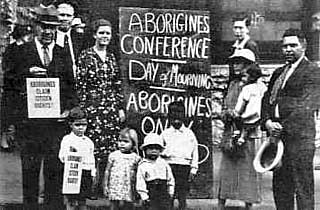 Many Aboriginal people commemorate 26th January as the 'Day of Mourning'. Seventy years ago on 26 Jan 1938 about one hundred Aboriginal people gathered in Sydney's old Australian Hall in Elizabeth Street (after they were refused to meet in the town hall) in the first 'Day of Mourning and Protest'. They came from all over New South Wales and Victory and some probably came from as far away as Queensland. Other Aboriginal leaders sent their messages of support. To organise and attend this historic meeting was an incredible challenge at a time when Aboriginal people suffered severe restrictions in their freedom to move and several attendees slipped into the back entrance to avoid being seen and suffer reprisals.
At this historic meeting which is arguably the beginning of the Aboriginal rights movement, delegates discussed citizen and voting rights, representation in parliament, the abduction and enslaving of Aboriginal children and the return of stolen land. The meeting adopted a twelve page document titled 'Aborigines Claim Citizen Rights'. Here a few quotes from that manifesto:
"The 26th of January, 1938, is not a day of rejoicing for Australia's Aborigines; it is a day of mourning. This festival of 150 years' so-called "progress" in Australia commemorates also 150 years of misery and degradation imposed upon the original native inhabitants by the white invaders of this country." and
"We, representing the Aborigines, now ask you, the reader of this appeal, to pause in the midst of your sesquicentennial rejoicings and ask yourself honestly whether your "conscience" is clear in regard to the treatment of the Australian blacks by the Australian whites during the period of 150 years' history which you celebrate?" and
"You have almost exterminated our people, but there are enough of us remaining to expose the humbug of your claim, as white Australians, to be a civilised, progressive, kindly and human nation. By your cruelty and callousness towards the Aborigines you stand condemned...If you would openly admit that the purpose of your Aborigines legislation has been, and now is, to exterminate the Aborigines completely so that not a trace of them or their descendants remains, we could describe you as brutal, but honest. But you dare not admit openly that what you hope and wish for is our death! You hypocritically claim that you are trying to protect' us; but your modern policy of protection' (so-called) is killing us off just as surely as the pioneer policy of giving us poisoned damper and shooting us down like dingoes!"
Sadly seventy years later some of these statements are still accurate as long as you replace 150 years with 220 years.
We believe this year's Australia Day was a timely historic opportunity missed by Australia's new prime minister, a unique opportunity to heal the past by giving credit to those first Aboriginal activists, acknowledge the need to act on their demands and by saying 'Sorry' to all Aboriginal people on this particular day in order to make Australia Day a true occasion to celebrate for all Australians, including its original inhabitants.
Aboriginal people and their friends are waiting for Kevin Rudd to fulfil his election promise to say 'sorry'...- How much work the new government has cut out to improve the lot of Aboriginal Australians can be glimpsed from a new report published in the BMC International Health and Human Rights journal. Australia is singled out in this report as the only country that has not made any progress towards closing the gap between Aboriginal and general population in education, health, life expectancy and economic standard. The situation is even worse as the gap in Australia has actually widened. So let us hope that the new government will take immediate and effective action!
And for all of you who buy any Aboriginal arts or crafts, please ensure that Aboriginal people benefit! Thanks - The Aboriginal community of Wadeye has been in the news repeatedly for unrest and violence. Over Christmas two gangs have engaged in open street battles, throwing stones, spears and iron bars at each other. The local police are unable to stop the violence of hundreds of people in the streets of the town, which is isolated by heavy rains.
What is happening in Wadeye is that two distinct Aboriginal clans in the town are fighting each other. What traditionally resulted in the warring parties ending up moving further apart, today simply continues month in and month out. It is high time that the NT government realises that the situation was created when missionaries and police took Aboriginal people from different clan groups to the then Wadeye mission. The ancient clan rivalry continues to flare up, especially when the remote community is cut off for months during the monsoon. Maybe the government will have to establish separate communities for both clans on their traditional land. We are pretty certain that this would eliminate further suffering and bloodshed between the two family groups.  The former Liberal government had introduced 'baby bonuses' to reverse a declining birth rate. While a declining birth rate is not necessarily bad, this particular measure has a much more insidious side effect: many young - and even under-age - Aboriginal women are becoming pregnant solely to get the $4000 baby bonus. There is rumours of fathers telling their daughters to have a baby, so they can get a 4WD vehicle or Aboriginal men getting girls pregnant and then making off with the money.
In 2005, the year after the baby bonus was introduced, the fertility rate in Queensland for 15-19 year olds was 20.5 per 1 000 while Aboriginal girls in the same age bracket recorded 67 babies per 1 000.
The 1800 people Aboriginal community of Walgett in New South Wales, recorded 43 pregnancies in Aboriginal girls under 15. Why would any government encourage these trends???
In July 2008 the baby bonus is set to increase to $5000, increasing the incentive and incidence of misuse, while there is already plenty of anecdotal evidence of increasing Aboriginal birth-rates and problems for very young mothers.
We hope that the new government gets rid of the baby bonus as soon as possible. To pay people for having more kids in an already overpopulated world is simply stupid. To reward under-age pregnancies seems downright criminal.- To lighten up a bit, here two boomerang stories:
1) Boomerang comes back
The Mount Isa council recently received a parcel that contained an old boomerang, a check and an apology from a person in Vermont, USA. The boomerang was stolen from a museum in town in 1983. It is great to hear that the thief had some change of conscience, many Aboriginal people believe that taking what is not yours will bring you bad luck, especially if it a sacred object. This artefact will now be returned to his maker or his relatives.
2) Boomerang in space
The question is will a boomerang still come back in zero gravity. If everything goes to plan, Japanese astronaut Takao Doi will have a boomerang in his luggage when he flies to the space station in March. He even received personal training from Japanese boomerang master Yasuhiro Togai on how to throw a boomerang to make it come back. Takao is going to throw his boomerang inside of the space station and hopes to make it come back. This should settle argument about the necessity of gravity to make a boomerang come back.
We'd love to see him throw it outside of the station as well. Wouldn't it look a lot better and be a lot easier than in the cramped inside? While we do not think that the boomerang would come back, we are certain it would set a record for the furthest throw :-) - Friends of mine who attended the Woodford folk festival, Australia's biggest with over 120,000 people attending, reported that our local Aboriginal band 'Zenith' was one of the crowds favourites. It is wonderful to hear that Willie Brim and his sons are being recognised for all the hard work they put in over the years. Willie is the bloke who posed for our bullroarer picture and our youngest local elder.
And another North Queensland indigenous group, D.I.D.G. - N.Q. - The Deaf Indigenous Dance Group of North Queensland also performed at Woodford on their way to the National Deaf Games at the Gold Coast. These guys and girls are amazing to watch - they literally feel the music. All of us who can enjoy hearing could learn heaps from this inspiring dance troupe.
Keep on didjing until next month
from Svargo and the DIDJSHOP.COM team
To unsubscribe, please visit our subscribe / unsubscribe panel Use the same online control panel to update your email address, or to switch between HTML and plain text email format. |