November 2009 Newsletter from didjshop.com |
 Editorial Editorial
Would you like to get a beautiful didgeridoo delivered to your door totally for free? Sounds almost too good to be true, but three people will be in this enviable position early next year and you could be one of them.
All you need to do is to answer some interesting didgeridoo related questions and you will be in the draw for one of three Didjshop didjes valued at about $3000.
Why do we give away three didgeridoos for free? Because we are celebrating our tenth years of selling didgeridoos on the internet.
So this is a very rare and unique opportunity for you to win one of these three didjes. And your odds of winning are better than in almost any other competition and three times as good as in previous years. For some strange reason this year less people than usual have entered, even though there are three instead of the usual one didj to be won.
The competition closes on 31st December, so if you have not done it yet, enter the draw soon!
The last few weeks were quite intense as our main production worker left in September to be with his daughter in Brisbane, so now I am doing two jobs. I really enjoy working on the didjes myself again, but when Danniel left, we had about three hundred didjes in the works, so there was a lot to do to get them online so you can browse through them. You will be pleased to hear that over 170 of these new didjes are available online now, which was our biggest ever upload of new didjes (read more below).
You might be even more pleased to hear that we are having huge Christmas discounts on over eighty didgeridoos, as well as up to 40% discounts on Aboriginal canvas art, shields and spears.
If you have recently sent us an email and got a bouncer, sorry but we have changed our email addresses to reset the spam clock and it is wonderful to get emails now without any spam at all. Quite a change after about 250-300 spam emails every day, why don't these people get a life?!?
Talking about emails, I need to admit that my most favourite emails are the ones we get when customers tell us about their new Didjshop.com didj. There is nothing like the good feeling triggered by happy customers. It is so rewarding when the work and love gone into a didj is acknowledged by its new owner. So a big thank you to all of you who have sent us their appreciation. Please check out some of those customer comments we got over the last few weeks.
If you have ever bought a didj from us and haven't filled out our customer questionnaire, please do so (you will get additional entries to our 2009 didj competition).
We have just sent our first didj to a customer in Kuwait, which became the seventieth country we sent a didgeridoo to. The internet is wonderful, allowing us to sell into seventy different countries, something only multinationals were able to do before.
The internet also allows all of us to create our global didgeridoo circles four times a year, a circle which is growing every time and already spans most time zones.
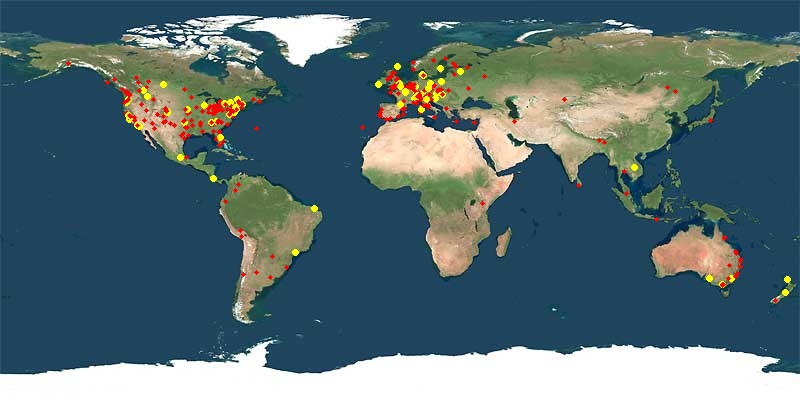 The last Worldwide Didgeridoo Meditation on 23rd September was very well attended and the biggest such event yet. We received registrations from 473 locations in 50 different countries all around the world and well over a thousand people would have participated. Since the list of participants is so long we list here just those countries in alphabetical order: Argentina, Australia, Austria, Belgium, Bermuda, Bhutan, Brazil, Canada, Chile, Colombia, Costa Rica, Croatia/Hrvatska, Cyprus, Czech Republic, Denmark, Ecuador, Estonia, Finland, France, Germany, Greece, Hungary, India, Indonesia, Iran, Ireland, Italy, Japan, Kenya, Latvia, Luxembourg, Macedonia (FYR), Malaysia, Mexico, Netherlands, New Zealand, Norway, Paraguay, Peru, Poland, Portugal, Russia, Spain, Sri Lanka, Sweden, Switzerland, Thailand, Ukraine, United Kingdom and USA. You can check the full list of participants HERE. The last Worldwide Didgeridoo Meditation on 23rd September was very well attended and the biggest such event yet. We received registrations from 473 locations in 50 different countries all around the world and well over a thousand people would have participated. Since the list of participants is so long we list here just those countries in alphabetical order: Argentina, Australia, Austria, Belgium, Bermuda, Bhutan, Brazil, Canada, Chile, Colombia, Costa Rica, Croatia/Hrvatska, Cyprus, Czech Republic, Denmark, Ecuador, Estonia, Finland, France, Germany, Greece, Hungary, India, Indonesia, Iran, Ireland, Italy, Japan, Kenya, Latvia, Luxembourg, Macedonia (FYR), Malaysia, Mexico, Netherlands, New Zealand, Norway, Paraguay, Peru, Poland, Portugal, Russia, Spain, Sri Lanka, Sweden, Switzerland, Thailand, Ukraine, United Kingdom and USA. You can check the full list of participants HERE.
Let us aim for 500 locations in 50 countries for the next Worldwide Didgeridoo Meditation on 22nd December 2009! Please help to make this happen by committing to participate and by registering your location. We guarantee you will enjoy the event. Please also tell your friends about it. With the internet they are only an email away, no matter where they are in the world.
You can also check out on our world map whether there is anyone in your area already registered and can contact them (its even more fun to do this together with friends).
Upon reading the story about the possibility of the climb of Uluru being closed in our last newsletter, Hillel (a long-time subscriber) suggested that we ask all of you to please send an email to Peter Garrett expressing your feelings on the issue. For those of you who have not read the story, Traditional owners would like the Uluru climb to be closed, but tourist operators want it to continue because they fear that tourists will no longer come. For Aboriginal elders it is a bit like someone abseiling from the Vatican and what is worse is that there are no toilets on top of Uluru, so people relieve themselves all over the place, which does not just desecrate this most sacred site, but it also interferes with the natural balance of the environment.
So if you want to do something for Aboriginal people, please write a quick email to Peter Garrett asking him to please close the Uluru climb. Maybe encourage him by assuring him that you'd be much more likely to visit this Aboriginal sacred site once it is properly respected.
Thanks Hillel for your suggestion. Together we might sway the minister's view and help to finally stop tourists trampling and sh...ing on this sacred Aboriginal site.
Enjoy the rest of this newsletter...
Svargo
|
 Lots of new Didjes and Big Specials Lots of new Didjes and Big Specials
Many New Didjes
We have just done our biggest ever upload of didgeridoos. It sounds unbelievable, but we have just added over 170 new didjes into our online virtual shop. You will not find any other seller who has that many didjes on offer in total, never mind brand new ones. With now over 400 didgeridoos to choose from, Didjshop.com surely remains the biggest Didgeridoo Shop by far.
And let me tell you it does take a lot of work just to get these didjes onto the website, at least the way we do it. Each one has to be sound graded and the sound attributes determined, this alone takes many hours with so many didjes. Then each one has to be photographed and the photos need processing. Next most didjes are recorded and the sound files are processed. Last not least all the information about each didj needs to be entered into the database and everything needs to be double checked. Sounds easy, but do it with over 170 didjes and it becomes a major undertaking. So I am very relieved that it is finally done. And by the looks of it our customers are too, as surprisingly many of these new didjes have already sold in the last few days.
As you can imagine with that many new didjes there are many different sizes and types of didgeridoos, from 85 to 238 centimetres long, from 1.1 kg to 13.5 kg heavy, from a key of high B to a low E, from 2nd to high concert sound quality.
You can find some really Long didjes including a didj in the key of low E. For all we know this might be the only didj in this key for sale anywhere. Imagine droning at an incredibly low 41 Hertz!
Or you might be more interested in checking out some of the new Aboriginal Flag didjes, Artefact Didjes, Cheap Learners, Concert Learners, Fine Art Didjes, Great Players, Healing Didjes, Rare Keys or Traveller Didjes.
Those are the type departments which all have many new didjes to choose from.
If you prefer to browse through only the new didjes, you can CLICK HERE. Please note this link is available only form this newsletter.
 Christmas Specials Christmas Specials
We usually have a special offer for Christmas and because this year we had few specials, this one is going to be a big one.
What we will do is offer you big discounts lasting for six weeks on over 80 didjes. Some are discounted by 10%, others by 15% and some you can get even 20% cheaper. And this is not all. These discounts will apply for fifteen days (from 16 November until 30 November) and if these discounted didjes have not sold by then we will increase their discount by 5% (so they will be between 15 and 25% cheaper from 1 December to 15 December). Whichever didjes are still left over after four weeks will then be discounted a further 5%. So from 16 December to 30 December you can buy didjes at 20-30% less than normal retail price!!!
That is if no-one else has bought that particular didj earlier.
So you can wait for the end of December and risk loosing the didj you like, or you can buy it now for a lesser discount and be certain to have gotten a great bargain on the didj you like the most. We thought this will make it more interesting and challenging for all of you.
We have discounted almost every didj which has been in our virtual shop for longer then three month (except the Didjshop Collection didjes). This means that there is a broad range of didjes discounted and you can find a bargain no matter what sort of didj you are looking for. But some types of didjes have only a few discounted ones, so we suggest you check out the type of didjes you are interested in as soon as possible. If you are interested in several didjes on special, you can afford to wait while you keep watching them, but if there is only one or two which suit you, we suggest you do not wait too long...
To see all didjes on special offer, CLICK HERE.
 And there are even bigger discounts on Aboriginal canvas art! And there are even bigger discounts on Aboriginal canvas art!
We offer a whopping 40% discount on large canvas art and medium canvas art and a 30% discount on all small canvas art, shields and spears.
So if you ever wondered about getting some original Aboriginal artwork to hang on your wall, now is your opportunity to get it at near cost price!
All of these discounts will finish on 30th December.
|
 Aboriginal People and Western Drugs Aboriginal People and Western Drugs
There are currently many reports about the increase of marijuana usage in remote Aboriginal communities with some reports claiming that marijuana usage in Aboriginal communities has increased dramatically since petrol sniffing has been reduced through the introduction of opal. While some media seems to portray this as a major problem, let us have a closer look behind the hype and at how Aboriginal people react to different Western drugs as well as whether they used drugs before white man came along.
Let's start with the recent news stories. Alan Clough from James Cook University who for the past 10 years has researched the use of marijuana in Eastern Arnhem land, claims that about 60% of Aboriginal people between 13 and 34 years old use cannabis at least weekly, which is awfully high.
Alan Clough points out: "The rates of profits that the dealers can make are really unlimited. They basically charge what the market will bear."
We agree and have heard anecdotes of one gram of dope going for a hundred dollars or more in Arnhemland and an ounce trading for well over a thousand dollars. Someone is clearly making lots of money and we doubt it is Aboriginal people. Arnhem land really has only one road going in and that is quite well policed with the use of sniffer dogs, but there are numerous airstrips where the drugs seem to be coming in and police seem to be turning a blind eye. There cannot be too many planes flying around and spot checks of planes can probably catch some big boys, but this is just not happening.
Jonathon Nicholls from Uniting Care Wesley reports similar stories from the Anangu Pitjantjatjara lands in South Australia. He said. "If you've got someone in your family who's addicted to cannabis and it's been sold out there at a high cost, then that family isn't going to have money to put food on the table."
While this rip-off is deplorable, we have also heard several stories of boot-loads of Aboriginal art being traded for a carton of beer or of grog being sold for 5-10 times its usual price to Aboriginal people.
Just last week a bottle shop in Alice Springs apparently accepted a bush tucker painting as payment for a carton of beer and a bottle of wine.
 While we do not condone marijuana smoking, we do dare to point out that it is the least evil of the western drugs which Aboriginal people have been exposed to since the arrival of white man. While we do not condone marijuana smoking, we do dare to point out that it is the least evil of the western drugs which Aboriginal people have been exposed to since the arrival of white man.
Petrol sniffing has claimed many lives and ruined many more and it is wonderful to see a significant drop in its use through the introduction of non-sniffable opal fuel. Regular readers would be familiar with the stories we have shared in the past on this topic and I will never forget the hollow eyes of the Aboriginal teenager standing in front of me at Mutitjulu (near Uluru) with his coke can which had petrol in it - a lost soul if I have ever seen one and a permanent liability for his community.
Alcohol is also certainly a lot worse than marijuana and alcohol fuelled rages have killed and maimed many innocent Aboriginal people, especially female partners of the perpetrators.
As I have said before I know hardly any Aboriginal person who can have a drink like most of us can. Either they do not touch the stuff or they get blind drunk, with very few exceptions. The cost of alcohol to Aboriginal family budgets and their health are immense.
So while drug abuse is detrimental in any case, in our view marijuana is the least of all evils. What we hear over the grapevine is that the high THC strains introduced into Australia over the last ten years are the source of most psychological problems associated with cannabis use. So legalising this drug and regulating its sale and potency could actually result in better health and lower financial impact for Aboriginal families (and the wider Australian population).
Some people claim that Aboriginal people must be genetically predisposed to become more addicted to drugs and on first sight it seems plausible. They seem to not be able to stop after one or two glasses of beer and many keep sniffing petrol or drinking alcohol or smoking pot until they either have no more drugs or are totally out of it.
Yet I am not sure whether this is a genetic predisposition. I used to work with drug addicts and found that the lower the social standing and the more hopeless the perceived situation of a drug addict was, the stronger was his/her usage. So maybe the fact that so many Aboriginal people are so strongly addicted to drugs has more to do with the almost total loss of their culture and identity and their usually very low social status.
Maybe Aboriginal drug use is a symptom, not a genetic predisposition.
Another indication for this is that Aboriginal people have used natural drugs since many generations.
I have heard about little green berries with black seeds which make you more alert, give you extra energy and suppress your hunger; about certain ground orchid seeds which are hallucinogenic, about potions which put you asleep and so on.
So drugs as such are nothing new to Aboriginal society.
However from what I have heard these natural drugs have been mostly used in a cultural context and were not abused to forget about a hopeless situation. Aboriginal society was inclusive of all members of the community unlike our Western society which seems to promote riches despite knowing that riches for some require squalor for many.
Today most Aboriginal people have lost most of their culture and this alone makes them much more susceptible to substance abuse. Being generally at the bottom of the social ladder in a country which was taken from their ancestors and is now raped and pillaged is conducive to taking any drug which helps to forget the atrocities and inequalities experienced.
Yet this is no excuse. What Aboriginal people need to do is accept that their life is their responsibility and that to have a roof over their heads is their responsibility and that their health is their responsibility.
Aboriginal people have to rediscover their pride and their spirit and learn whatever it takes to make their communities functional and sustainable. To keep on depending on white people to provide everything is not just not working, but is just like another drug.
In fact white people in the business of helping Aboriginal people are not interested in real solutions, they want the welfare dependency to continue as this is what they make their money with.
So in my view the most important dependency Aboriginal people have to break is not drugs, but their welfare dependency. Once communities become self sufficient and culturally strong, drugs will no longer be a problem.
|
 Didjshop Didgeridoos Didjshop Didgeridoos
In a survey of over 800 Didjshop.com customers, over 50% rate their new Didjshop didj as better or much better than it was advertised to be on the Didjshop.com website. A further 45% of our customers rate their new didjshop didj as being exactly what we claim it to be on our website. That is over 95% of customers who think that our rating system is accurate or even conservative.
Check out a few of the comparisons our customers have made (during the last two month) between their new Didjshop didjes and other didjes they own or have played:
- Anonymous from France: "The price is 50% less, the quality and aboriginal is guarantee with you and the sound, my god !!!"
- David from United Kingdom: "More expensive but there is no comparison in sound, quality and value. al876 is by far better than the other didjes"
- Marcel Canisius from Netherlands: "Very good! everything this didj has is valuable to me"
- Patrick from Belgium: "Better price quality ratio compared with products I saw in French shopping websites"
- Jacquelyn McDonald from USA: "Much better"
- Stanislav Andolšek from Slovenia: "It is the best one - sound quality"
If you ever bought a didj from Didjshop.com, please participate in our customer survey for your chance to win one of three fantastic didjes valued at over A$3000.
 Do you ever wonder what people think about our website and whether we can be trusted? Wonder no further, rather check out what our visitors say: Do you ever wonder what people think about our website and whether we can be trusted? Wonder no further, rather check out what our visitors say:
- Dillon Whitaker from USA: "This is the only site I've found that rates their own didgeridoos and admits that not all your didgeridoos are "the best to be had""
- Anssi from Finland: "Greatest of them all. Lots of information and layout is excellent. Sound clips are great and photos are of good quality. Only site I can honestly recommend to anyone interested in didgeridoos."
- Anonymous: "Excellent presentation. excellent advice. excellent product."
- Matthew Brewster from Guernsey: "So easy to navigate great pictures fantastic helpful staff and super prices"
- Ryan Anderson from Australia: "The best didj site on the web not just a store but a real community. Easy to navigate great newsletter and the forum is well moderated and full of great content. Love it!"
- Susan from USA: "Your site is by far THE best and most ethical. The newsletter is extremely informative and I appreciate greatly the section that deals with Aboriginal issues."
- Anonymous from Australia: "I think the level of information is fantastic. It is nice to know that purchasing a didge from you is of direct benefit to the Aboriginal community. The Didgeridoo's you have a truly stunning."
Please feel free to read more Didjshop comments.
Thanks to all of our customers and visitors for their valuable and wonderful feedback.
|
 September & October Winners! September & October Winners!
The September winner of our monthly A$50 shopping voucher draw is Adam Rooney from Inverness in Scotland, UK.
Adam said this about his new didjshop didj: "I like the design and artwork on it". He also rated its sound quality as better then what we advertised it to be.
and this is what Adam said about our service and workmanship: "workmanship is very good and service was excellent"
Thanks Adam for your kind words and congratulations on your win.
 The winner of our October draw for a A$50 shopping voucher at www.didjshop.com is Levi Rodney from Cabot in USA, who bought a didj for a relative in Ireland. The winner of our October draw for a A$50 shopping voucher at www.didjshop.com is Levi Rodney from Cabot in USA, who bought a didj for a relative in Ireland.
Levi had this comment on our website: "The first thing I thought was the way they explained why someone would want to be a customer at this site was excellent."
We particularly like what Levi shared about playing didj for long periods of time: "I felt a relief like my troubles went away and I was calm."
For those of you who cannot circular breathe yet, hang in there and keep working on it. Once you get the hang of it, the rewards are rich! If you need more inspiration, please read some more experiences of playing didgeridoo for long periods of time.
Congratulations, Levi and thank you for sharing your comments and experiences.
|
 Aboriginal News Aboriginal News
Last month Aboriginal news has some interesting and even several positive stories:
- Uluru has been in the news again several times. First for the opening of the new sunrise observation area and board walk. Aboriginal elders helped to choose the new site and believe that the new Talinguru Nyakuntjaku platform will provide tourist with spectacular sun-rise views of Uluru (including Kata Tjuta in the background). Traditional owner Mick Starkey said: "The new viewing platform on top of the sand dune system is going to give a better insight of how Uluru fits inside the cultural landscape of more vegetation and obviously you'll get Uluru and Kata-Tjuta in the same shot."
The Anangu traditional owners also hope that the new facility will discourage people from climbing Uluru.
The other news about Uluru indicates that such a ban is not just important in order to respect the wishes and believes of Aboriginal people, but also to protect the environment:
The Branchinella Latzi shrimp, which used to live in the various rock pools on and around Uluru, has not been seen since about 1970. Retired university professor Brian Timms believed the shrimp might be extinct due to excessive fertilisation of the area: "Latzi is a very limited species and it might be susceptible to enrichment of the pools whereas [the other species on Uluru] is a widespread, tough species," he said. "Certainly if they [tourists] go up, they should be behaving themselves, not pooing on the rock."
We wonder what would happen if people climbed on the Vatican or the Kaaba or other temples and relieved themselves there. Yet some people expect Aboriginal elders to tolerate such desecrating practices.
Please speak up for the Anangu traditional owners and Australian Aboriginal people in general by emailing the minister Peter Garrett and asking him to please close the climb onto Uluru.
 The ongoing saga of the federal intervention into Aboriginal communities is not going to quietly go away. The ongoing saga of the federal intervention into Aboriginal communities is not going to quietly go away.
The Australian Human Rights Commission has just issued their guidelines on how to make the Northern Territory Intervention comply with the Racial Discrimination Act, which the Federal Government wants to reinstate by November 26.
Some measures of the intervention, like restricting welfare payments and tying such payments to children's school attendance, are not legal under the Act. This is why the previous Howard government simply repealed the act, so it could invade Aboriginal communities and force their will onto them.
Race discrimination commissioner Graeme Innes says the new guidelines will provide information to the Government on how it could make such measures comply with the act.
This sounds like a clever attempt to keep doing things which are discriminatory, but doctoring the wording so it conforms with the act. So no real change, only cosmetics.
When will this government finally understand that real solutions requires a stop to treating Aboriginal people like children and to start supporting Aboriginal communities to do what they want and to find their own solutions. Did you know that only 14.9% of Indigenous sexual assault survivors report the crime. Only about half of those reported sexual assaults go to court and only less than 15% of those lead to a conviction. This means that over 98% of Indigenous sexual assaults goes unpunished. Did you know that only 14.9% of Indigenous sexual assault survivors report the crime. Only about half of those reported sexual assaults go to court and only less than 15% of those lead to a conviction. This means that over 98% of Indigenous sexual assaults goes unpunished.
Researchers at the Melbourne university have recently analysed the data of a social survey of Aboriginal people done in 2002/2003. They found that Aboriginal mothers were three times as likely to be at the receiving end of violence if they are members of the stolen generation (who were removed from their family as children). This is yet another indicator that the destruction of social structures in Aboriginal society by white governments and churches has lead to and is still contributing to the appalling social conditions in Aboriginal society.
It is not really surprising that a society robbed of its culture and its social norms and rules has problems with violence and drug abuse (see story above). What the Australian government needs to do, if it really wants to address this problem, is to assist Aboriginal communities to rebuild their culture and social order.- In related news, on any given day there are about 630 juveniles in Australian jails, 60% of which are Aboriginal people. In the Northern Territory these figures are even worse. Of the 35 juveniles in jail on any given day, 32 (or over 90%) are Aboriginal. And these juveniles spend an average of 79 days in jail before they have their day in court.
And Aboriginal people are not treated very well when they are in jail as a recent report by the office of the Ombudsman reveals.
For example there was the Aboriginal man who happened to be intoxicated and asleep in front of premises which were burgled. Police picked him up and accused him of having committed the burglary. During the police interview (which was later reviewed by the Ombudsman) police officers called him a "dumb f...", a "f...ing looser" and a "f...ing retard" as well as using other expletives. The ombudsman's report also stated that the officers served the man toast and milk "which appeared to have been taken from rubbish sitting on the bin."
Relating to another incident, where a juvenile was badly beaten by another prisoner, the report stated:"The JRC found that the senior auxiliary failed in his duty of care by deciding to house another person and the juvenile in the same cell, when the hostility between them was clearly displayed," the report states.
The officers involved received "managerial guidance", but no charges were laid against. We are certain that if they were working in any other profession they would at least have lost their job...
These were only two of about 260 complaints made against the Northern Territory police to the ombudsman.
One would think that politicians would notice that the heavy handed policing approach is not working too well and that the way police is treating Aboriginal people is significantly contributing to the growing resentment and hate in Aboriginal communities.
And the good news is that some actually do. Independent Northern Territory politician Gerry Wood is calling on the NT government to spend $300 million, which are earmarked for a new prison, on a prison farm instead.
Similarly Wangan & Jagalingou elder Duncan Johnson has called for prisons to be owned and run by Aboriginal people to accommodate the more than 1500 Aboriginal people languishing in jail. Duncan correctly points out that: "we could put programs in place that would be more suitable and we can't do that within the restrictions that we have within the corrective system."
Hopefully the government will listen and hopefully they are at least going to invite Aboriginal elders to be involved in the running of jails and in rehabilitation of Aboriginal prisoners.
- The Jawoyn association (Jawoyn land is around Katherine and up into Arnhemland) is currently compiling what they claim to be the world largest rock art database. They have discovered over three thousand rock art sites on their ancestral lands as well as stone axes, spears and other artefacts. What is amazing is that the first of these rock art sites were discovered only six years ago!!! If over three thousand rock art sites were discovered just in this relatively small area, what else is there waiting to be discovered. There are obviously many sites still to be discovered and to be recorded as far as Aboriginal rock art is concerned and it would be wonderful to have an Australia wide database covering all rock art and other Aboriginal sites in the country.
Hopefully I can share a story about preserving some local rock art with you in our next newsletter...
|
Keep on didjing until next month ...
from Svargo and the DIDJSHOP.COM team
_--_|\
/ \
\_.--._ /
v
|
To unsubscribe, please visit our subscribe / unsubscribe panel
Use the same online control panel to update your email address, or to switch between HTML and plain text email format. |
|
|